The Category Blind Spot
When rental operators talk about competitive pricing, they almost always mean economy and compact cars. That makes sense they're the highest volume, the most price-sensitive, the ones that drive conversion rate most visibly.
But here's the problem with that framing: the categories you're not watching closely are often the categories with the most pricing power.
This article looks at how to systematically find pricing gaps across your entire fleet not just the segments you already think about and how to use competitor data to close those gaps intelligently.
Why Category-Level Pricing Behaves Differently
Different vehicle categories have fundamentally different demand structures.
Economy & Compact High volume, high price sensitivity. Customers comparison-shop aggressively. A $3-5 difference moves bookings. You need to be competitive here, but margins are thin.
Intermediate & Full-Size Moderate sensitivity. Business travellers and leisure customers who want comfort without paying for an SUV. Often a sweet spot for margin improvement.
SUVs Demand spikes sharply for family travel, ski seasons, and long road trips. Supply is constrained relative to demand in many markets. Customers are significantly less price-sensitive they need the space.
Minivans Extremely inelastic demand. A family of six doesn't have a great alternative. Availability pressure is fierce during summer and school holidays. Operators who hold price here are often leaving 20-40% margin on the table.
Luxury & Specialty Low volume, but high margin. Competition is thinner. The right pricing data can help you find the true market ceiling.
The Gap Analysis Framework
To find where you're under- or over-priced by category, you need to look at three things simultaneously:
1. Your Rate vs. Market Average
For each category, where do you sit relative to the average of your top 3-5 competitors? Are you consistently 10% below market in minivans? That's money you're giving away. Are you 15% above market in economy? That's conversion rate you're losing.
2. Availability Pressure
When competitor inventory in a category is low, their willingness to hold or raise prices increases. If you can see that your top three competitors are all low on SUVs this weekend, you have pricing power you might not be using.
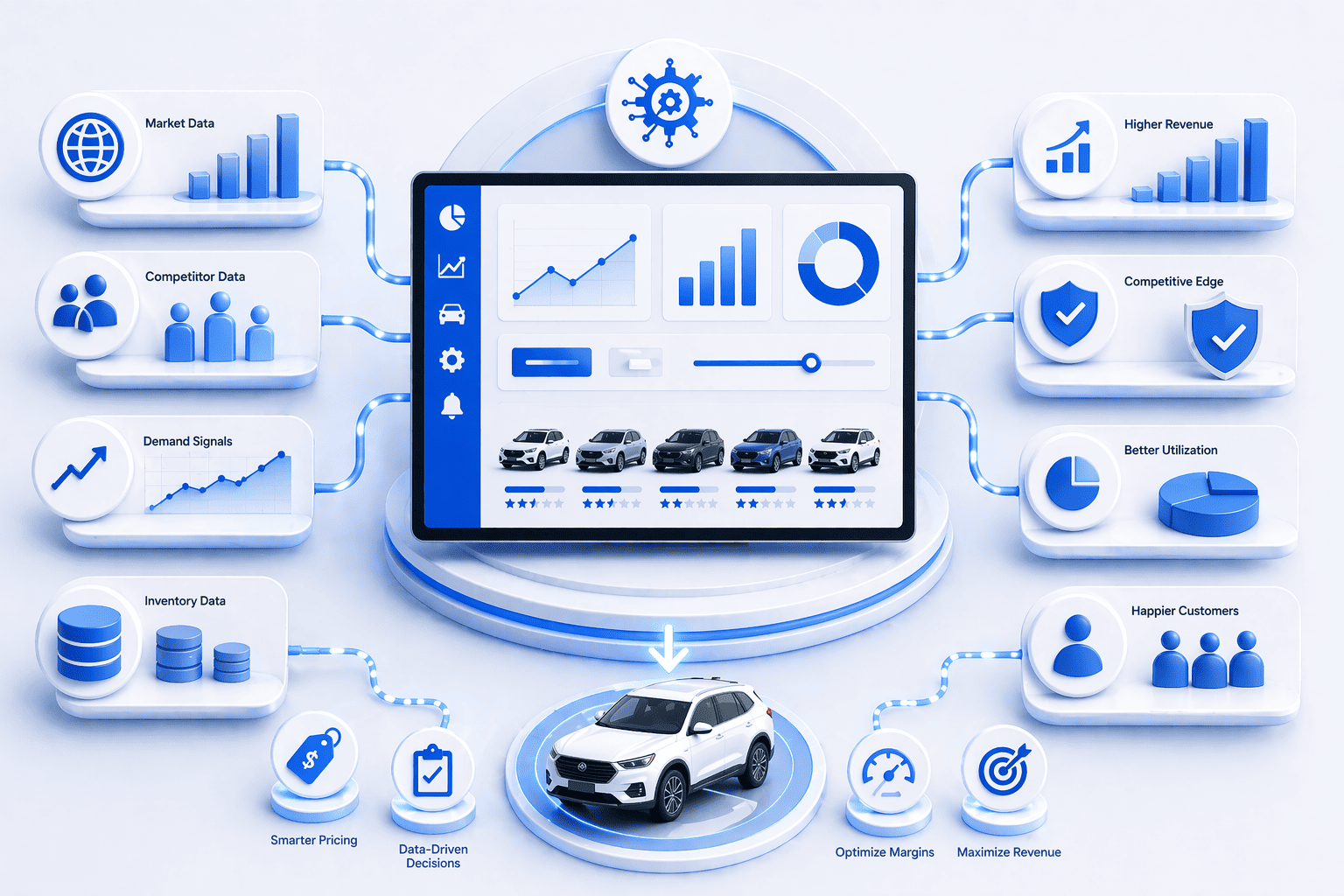
AutoRentalRate surfaces availability pressure alongside rate data so you can see both signals at once not just where you're priced, but whether the market conditions justify moving.
3. Rate Trend Direction
Is the market moving up or down in this category? If competitors have been steadily increasing SUV prices over the last 5 days, following them is rational. If they've been dropping, there's likely a demand softness you should be aware of before you start chasing.
A Real-World Category Gap Example
One mid-sized airport operator using AutoRentalRate ran a category analysis across their fleet for a 90-day period. Here's what they found:
| Category | Their Rate vs. Market | Booking Impact |
|---|---|---|
| Economy | -4% | Slightly over-capturing low-margin bookings |
| Compact | +2% | Healthy position |
| Intermediate | -12% | Significant under-pricing |
| SUV | -8% | Leaving margin on constrained inventory |
| Minivan | -21% | Biggest gap almost no competitive pressure |
| Luxury | +5% | Justified by product quality |
The intermediate, SUV, and minivan gaps were not the result of a deliberate strategy. They were the result of not having clear data. Rates had been set months earlier and never revisited in the context of what competitors were actually charging.
Adjusting these three categories brought an average rate improvement of 11% across the fleet without touching economy or compact, and without any change in overall booking volume.
How to Act on Category Gap Data
Finding a gap is step one. Acting on it correctly is step two.
Don't move all underpriced categories at once. Pick the category with the most clear market support where competitors are holding or rising and test a rate increase there first. Watch for 48-72 hours. If bookings hold, move the next category.
Use availability as your trigger. The best time to close an upward gap is when competitor availability is constrained. The market will absorb your higher rate because alternatives are disappearing.
Set alert thresholds. In AutoRentalRate you can configure alerts for each category so if your SUV rate falls more than 10% below the market average, you get notified immediately. You don't have to check manually; the system tells you when action is warranted.
Review seasonally. Category demand profiles change dramatically by season. Your summer SUV pricing strategy should not be your winter one. Run a fresh gap analysis at the start of each quarter, or monthly if your market moves fast.
The Minivan Opportunity
One category deserves its own call-out: minivans.
In most markets, minivan demand is concentrated into a relatively small number of high-need, low-alternative bookings. A family travelling to a wedding doesn't want a compact. They need the van. They will pay meaningfully more than they'd pay for an economy car, and the presence or absence of a $15 price gap with a competitor is rarely the deciding factor.
Despite this, AutoRentalRate data consistently shows minivans as the most underpriced category across independent operators. Rates are often set by applying a standard premium over the compact rate not by looking at what the market will actually bear.
Running a category gap analysis on minivans alone is often one of the fastest wins available to operators who have never done it before.
Start With the Data
The operators who are winning on category pricing are not smarter than the ones who aren't. They just have cleaner data, updated more frequently, covering more of their fleet.
AutoRentalRate gives you category-level rate breakdowns for every competitor you track, updated daily. If you've been managing pricing by intuition or weekly manual checks, there's almost certainly a gap analysis waiting to be run that will tell you something you didn't know.
The question is how long you want to wait before running it.